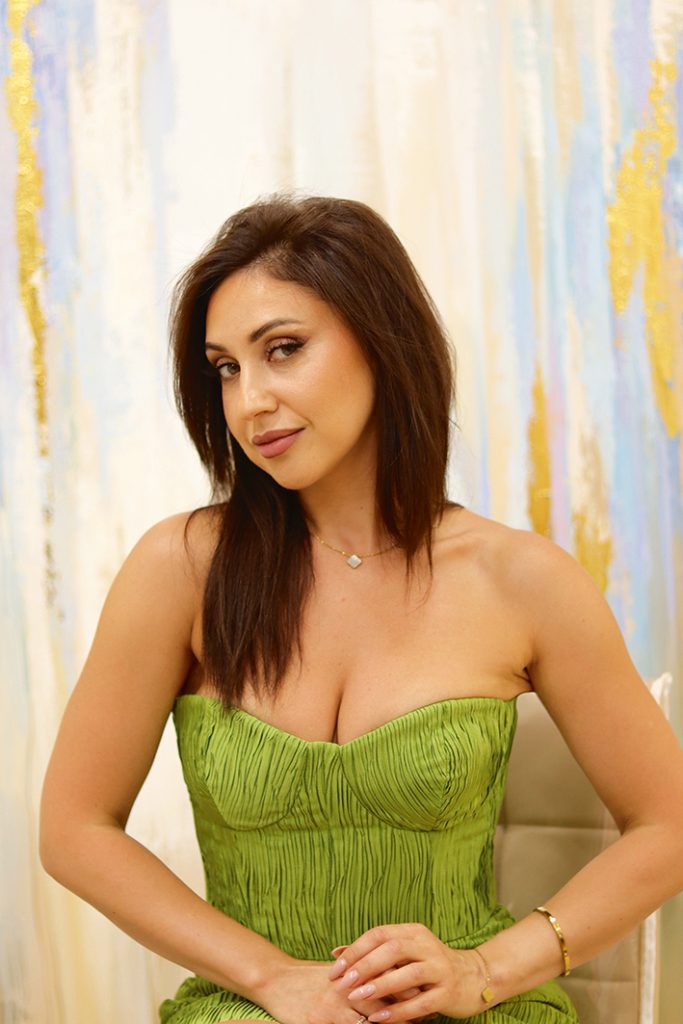
1. Lorena, your journey from professional ballroom dance and fashion modeling into floral design is both unexpected and inspiring. How did your years in movement and couture shape the way you approach composition, texture, and storytelling in your floral work? Do you feel your background allows you to see flowers differently from traditional designers?
Absolutely — this was always at the core of my vision. Both my dance career and my years in modeling shaped the way I follow form and movement in my work, and how deeply I value color as an aesthetic language — not just the flowers themselves.
I’ve always paid attention to the smallest details: the ribbon, the silk elements I weave into bridal bouquets, often reminding me of ballroom gowns. Every dress carried a story — a bird in flight, a season, a butterfly translated into silk. In the same way, each of my floral compositions tells a story through color, texture, and the vessels that hold them.


2. Growing up with an Eastern European sensibility and a deep love for wild botanicals, how have your cultural roots influenced your aesthetic language? In what ways do heritage, memory, and landscape inform the color palettes and emotional atmosphere you create?
My Eastern European roots shaped my personality and visual language, and that sensibility lives naturally in my work. I grew up surrounded by wild landscapes and untamed botanicals — flowers that feel both delicate and resilient. That duality continues to guide my compositions today.
Wildflowers, especially daisies, are my soul flowers. Their simplicity and quiet strength echo the landscapes of my childhood, and I often return to them in my designs.
Living in New York expanded my palette and perspective. My style became a dialogue between my Moldavian heart — wild and free — New York elegance and creative edge, and the gentle restraint of Japanese floral aesthetics. Together, these influences shape the color, form, and emotional atmosphere of my installations.

3. Your work is often described as living at the intersection of fashion and flowers. What does “couture floristry” mean to you personally?
To me, couture floristry is the art of approaching flowers the way couture approaches fabric — with precision, intention, and imagination. Each bloom carries its own silhouette, texture, and attitude, like a garment in nature.
I translate the drama and refinement of high fashion into living materials through a rigorous selection of flowers, chosen for movement, character, and emotional tone. Whether for a photoshoot, film, magazine, or an arrangement inspired by a place or artwork, the process is deeply couture: editing and sculpting until the composition feels both alive and inevitable — like fashion in bloom.

4. Having worked across weddings, film productions, and immersive events, how does your creative process differ depending on the medium?
My process always begins with listening, but what I’m listening for changes with the medium.
For weddings, the narrative belongs first to the bride — her favorite flower, her color, the details she has carried for years. I honor those emotional anchors, then layer in my own aesthetic language.
For fashion events or film, the floral world becomes a fuller expression of my vision, created to complement the client’s concept — almost like a life story translated into flowers. I work with rare blooms chosen for character and movement, allowing their natural spontaneity to keep each composition alive.
5. Color and movement appear to be central elements of your signature style. When you begin a new project, what comes first?
I often begin intuitively — with emotion and atmosphere — and then translate that feeling through color, texture, and gesture. Fabric-like softness and movement are constant references in my work because I see flowers as forms that can echo the body and the garments around them.
In this example, I designed a very small spring bouquet to complete the hand-painted silk of the dress — almost as if the florals were gently emerging from the fabric itself. It felt like a soft welcome into spring, a garden imagined from within. The ribbon was cut from the same dress, adding a quiet layer of intention.
That continuity of material creates harmony and movement, so the arrangement feels alive — as if it belongs to the wearer and is subtly dancing within the space.
Model: Lorena Eni https://www.instagram.com/lorenaeni?igsh=MTJpNHRlY3d0M3hxcQ==
Flower Designer: Lorena Eni Flowers
Photo: Alex Iordache
Make-up: Veronica Guzun
Hairstyle: Daniela Ciornii
Dress: Zimmermann
| Cookie | Duration | Description |
|---|---|---|
| cookielawinfo-checbox-analytics | 11 months | This cookie is set by GDPR Cookie Consent plugin. The cookie is used to store the user consent for the cookies in the category "Analytics". |
| cookielawinfo-checbox-functional | 11 months | The cookie is set by GDPR cookie consent to record the user consent for the cookies in the category "Functional". |
| cookielawinfo-checbox-others | 11 months | This cookie is set by GDPR Cookie Consent plugin. The cookie is used to store the user consent for the cookies in the category "Other. |
| cookielawinfo-checkbox-necessary | 11 months | This cookie is set by GDPR Cookie Consent plugin. The cookies is used to store the user consent for the cookies in the category "Necessary". |
| cookielawinfo-checkbox-performance | 11 months | This cookie is set by GDPR Cookie Consent plugin. The cookie is used to store the user consent for the cookies in the category "Performance". |
| viewed_cookie_policy | 11 months | The cookie is set by the GDPR Cookie Consent plugin and is used to store whether or not user has consented to the use of cookies. It does not store any personal data. |